


Cinderella Me guides
Stella McCartney Shoes: Materials and Buying Questions
Understand Stella McCartney’s leather-free approach without assuming every material is vegan or plastic-free, and examine the Deny sandal examples.
Leather-free does not answer every material question
Stella McCartney launched her namesake fashion house in 2001. Her 1995 graduation from Central Saint Martins was an earlier milestone, rather than the founding date of the brand. This distinction helps place the label’s material choices in their proper history.
Stella McCartney states that its collections do not use leather, fur, feathers or exotic skins. Its materials FAQ also explains that it uses wool and that some leather alternatives contain synthetic coatings. “Leather-free”, “vegan” and “plastic-free” therefore answer different questions and should not be treated as interchangeable descriptions of every product.
If a particular material matters to your decision, ask for the composition of the exact pair. A leather-like appearance is not proof of leather, while a current innovation on the brand’s website does not identify the composition of an earlier design.
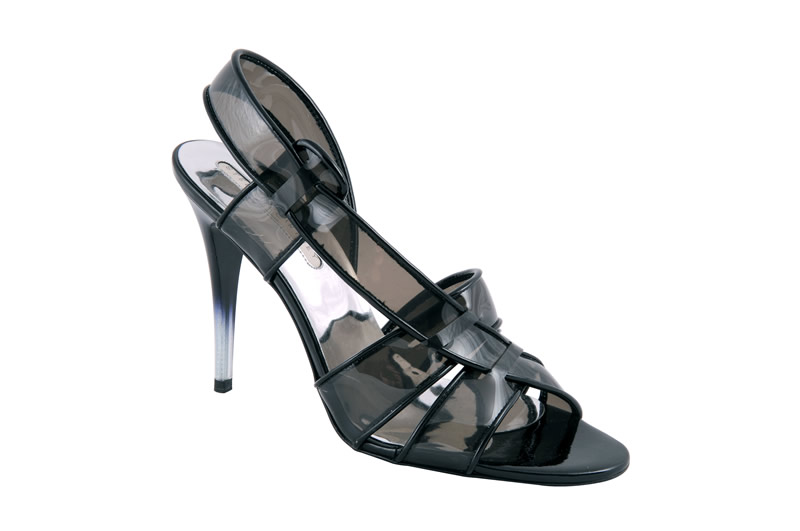
A product photograph from the CM catalogue. Check the listing for the exact size, materials, condition and current availability.
View productDeny: inspect the straps and the heel
The Cinderella Me catalogue describes Deny and Deny Purple with broad, asymmetrical straps and contrasting two-tone heels. Those visible design details are useful for comparison. The colour of a surface or the shape of a strap cannot establish its underlying polymer, textile or coating.
Broad straps should still be checked for position and pressure. Ask how the shoe is fastened and whether the relevant bands adjust. Do not assume a non-leather material will stretch like a familiar leather shoe, or that a different size will solve a mismatch in the strap layout.
Care for the actual surface
Begin with the supplied instructions or material-specific advice from the maker. Leather creams, oils and strong solvents are not default treatments for a coated alternative. If a surface is lifting, peeling or sticky, stop and obtain an assessment rather than trying to disguise it.
Inspect the heel finish and strap edges in close-up, and keep hard accessories from rubbing against them during storage. An environmental claim about a material is not a durability guarantee for the condition of an individual pair.
Graphic outfits and accompanying bags
A simple outfit can make Deny’s asymmetrical bands and contrasting heel more visible. Try an uncluttered trouser hem or a dress that leaves the straps unobscured. For the purple example, compare the colour with the outfit in natural light before committing to an exact match.
A bag can repeat the heel’s metallic accent or introduce a softer texture. If avoiding animal-derived materials is important to you, check the bag independently too, including its trim and lining; choosing a coordinated look is not the same task as verifying composition.
Use the examples without guessing
These are product/catalogue examples, not customer-worn photographs or endorsements. Current size choices and the condition of the selected pair belong to the product listing.
- Request composition information where the description is incomplete.
- Check the fastenings and the condition of coated surfaces.
- Treat broad sustainability language as background, not an item-specific certification.